Home › PAN Card Procedure To Apply
Whether you hold an Indian passport, a British passport or an OCI card, this page explains exactly how to apply for a PAN number from the United Kingdom — which form you now need, what documents to send, what it costs, how long it takes, and the mistakes that get applications rejected.
£37 per applicant, all-inclusive. Your adviser is assigned the same working day.
THE SHORT ANSWER To apply for a PAN card from the UK, choose the form that matches your citizenship — Form 93 if you hold an Indian passport, Form 95 if you hold a British or any other foreign passport, including OCI and PIO holders. Complete the form, attach photocopies of your passport and a UK address proof, sign it, and submit it to Protean (formerly NSDL), UTIITSL, or an independent PAN agency such as PanCard.co.uk. The government issues an e-PAN by email, followed by the physical card to your UK address. No Aadhaar, no Indian address and, in most cases, no notarisation are required.
You get the correct form, a completed sample, plain-English instructions and a dedicated adviser who checks your application before it is filed.
START YOUR PROCESS£37 per applicant • 50,000+ UK clients since 2007 • Pay in GBP
The whole procedure, from eligibility to the card landing on your doormat, in seven steps.
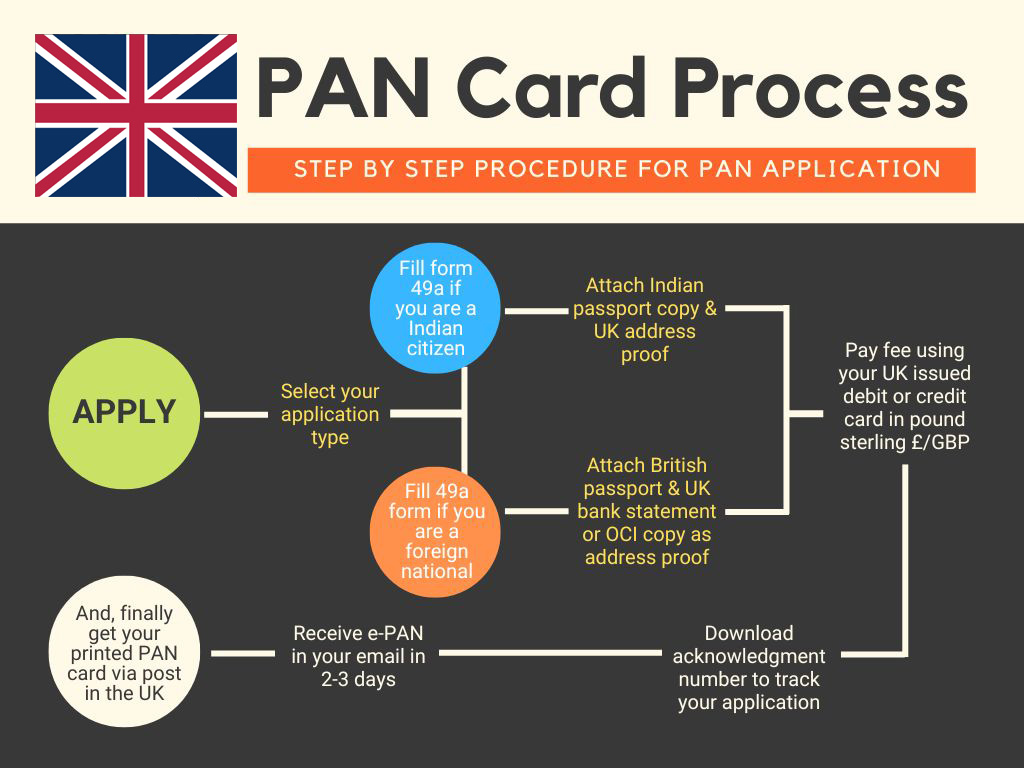
All three routes lead to the same PAN issued by the same department. They differ in who does the work, what currency you pay in, and what happens if something goes wrong.
| Route | How it works | Payment | Best suited to |
|---|---|---|---|
| Government portals
Protean (formerly NSDL) or UTIITSL |
You complete the form yourself online, upload documents, then post the signed acknowledgement to India within 15 days. | Indian rupees only, by net banking, Indian card or demand draft | Applicants with an Indian payment method who are confident filling official Indian forms |
| PAN centre in India
TIN-FC or UTIITSL branch |
The form and documents are handed in over the counter, usually by a relative acting on your behalf. | Indian rupees at the counter | Applicants visiting India, or with family who can attend in person |
| Independent PAN agency
such as PanCard.co.uk |
The agency identifies the correct form, prepares it, checks your documents, files the case and follows up on objections. You sign and post. | Pounds sterling, any UK debit or credit card | UK residents with no Indian bank account, no Aadhaar, or no wish to deal with Indian portals |
Worth knowing: independent agencies are not government bodies and cannot issue a PAN. What they do is prepare and submit the application correctly, which is where most UK applications fail. Only Protean and UTIITSL are authorised to process PAN applications on behalf of the Income Tax Department, and every route ultimately files through one of them.
Identify your category first. It determines your form, your documents and the route your application takes.
Adults, minors and Hindu Undivided Families holding Indian passports. Your visa type, ILR or Settled Status does not change this — only your passport does.
A British or other foreign passport held together with an OCI or PIO card makes you a non-citizen for this purpose. Select OCI or PIO as your citizenship type.
Any British or foreign national, adult or minor, with no OCI or PIO card. Select "Foreigner" as your citizenship type. An OCI card is not required to hold a PAN.
UK limited companies, LLPs, partnerships and trusts with no Indian registration. Indian-registered entities use Form 94 instead. See our company PAN page.
If you already hold a PAN and need a fresh card with the same number, that is a reprint request. Forms 93 and 95 are only for new PAN allotment.
Changes to your name, date of birth, address, photograph or signature go through the PAN change and correction request that replaced the old CSF form.
The single rule to remember: your passport nationality decides your form. An OCI holder with a British passport uses Form 95, not Form 93 — OCI status is not Indian citizenship. This is the most common mistake we see from UK applicants.
From 1 April 2026, under Rule 158 of the Income-tax Rules, 2026, the two old forms were split into four category-specific forms. Applications submitted on the old forms before 31 March 2026 continue to be processed — you do not need to resubmit.
| New form | Formerly | Who uses it from the UK |
|---|---|---|
| Form 93 | Form 49A (individuals) | Indian passport holders — NRIs, students, Skilled Worker visa holders, ILR holders who kept Indian citizenship |
| Form 94 | Form 49A (entities) | Entities incorporated or formed in India |
| Form 95 | Form 49AA (individuals) | British citizens, OCI and PIO holders, EU and all other foreign passport holders |
| Form 96 | Form 49AA (entities) | UK LTDs, LLPs, trusts and other entities incorporated outside India |
For field-by-field detail on each form, what changed and which documents each one accepts, see our complete guide to PAN Forms 93, 94, 95 and 96.
The online route suits applicants comfortable with Indian government portals and rupee payments. Here is what it actually involves from the UK.
The point most applicants miss: applying "online" from the UK does not remove the postal step. Unless you can sign with Aadhaar or an Indian DSC, a signed physical form with photographs still has to reach India. This is where most self-filed UK applications stall.

The offline route avoids the Indian portals and rupee payment altogether. It is the route most of our UK clients take, because everything except signing and posting is handled for them.
No Indian embassy attestation and no notarisation is needed in the great majority of UK cases. Plain photocopies are enough. Do not send original documents — they are not returned.
| Proof needed | Accepted documents (copy of any one) |
|---|---|
| Identity | Indian passport — first and last page |
| UK address | UK bank statement, UK utility bill, council tax bill, UK driving licence, or the address page of your Indian passport showing your UK address |
| Date of birth | Indian passport, birth certificate or matriculation certificate |
| Proof needed | Accepted documents (copy of any one) |
|---|---|
| Identity | British or foreign passport — the page showing your name and photograph, or your OCI or PIO card |
| UK address | OCI or PIO card page showing your address, UK bank statement, UK utility bill, council tax bill or UK driving licence |
| Date of birth | Passport, OCI card, PIO card or UK birth certificate |
| Proof needed | Accepted documents (copy of any one) |
|---|---|
| Identity | British or foreign passport — the page showing your name and photograph |
| UK address | The emergency contact page of your British passport, on which you may write your UK address; or a UK bank statement, utility bill, council tax bill or driving licence |
| Date of birth | Passport or UK birth certificate |
Aadhaar and Indian address: neither is required. NRIs outside India for more than 182 days in a financial year are exempt from the Aadhaar requirement, and foreign citizens are outside it entirely. Your UK address is accepted as the communication address on the form.
Photograph and signature errors are the most common technical reason applications are held up, and they are entirely avoidable.
| Requirement | Specification |
|---|---|
| Photograph size | 3.5 cm × 2.5 cm, colour, recent. Standard UK passport photos are accepted. |
| Background | Plain white or light coloured, face square to the camera, no sunglasses or head covering except for religious reasons. |
| Number of photos | Two — one in the top-left box and one in the top-right box of the form. |
| Signature ink | Black ink pen only. |
| Signature placement | Inside the box provided, roughly 2.0 cm × 4.5 cm. It must not run outside the box or over the left-hand photograph. |
| Signature across the photo | Where the form asks for it, sign across the right-hand photograph so part of the signature falls on the photo and part on the form. |
| Uploaded files (online route) | Photo: JPEG, 200 DPI, up to 20 KB. Signature: JPEG, 200 DPI, up to 10 KB. |
| Minors and thumb impressions | Where a signature is not possible, a left thumb impression is accepted but must be attested by a magistrate, notary or gazetted officer. |
What each route costs, in the currency you actually pay in — and how long each stage takes.
| Route | Fee | Paid in | Covers |
|---|---|---|---|
| Government portal — card to a foreign address | ₹1,017 (approx. £10) | INR only | Processing and overseas dispatch |
| Government portal — e-PAN only | ₹66–72 | INR only | Digital PAN, no printed card |
| PanCard.co.uk | £37 per applicant | GBP, any UK card | PAN Kit, government fee, our handling, adviser checks and delivery to your UK address |
| Stage | Indicative time |
|---|---|
| Application status visible online | 24–48 hours after submission |
| e-PAN emailed to you | 2–3 working days |
| Printed card delivered to a UK address | 3–4 weeks |
These are the indicative timings published by the government and can change. Postal delivery to the UK depends on India Post and Royal Mail handling.
When your application is accepted you receive a 15-digit acknowledgement number from Protean, or an application coupon number from UTIITSL. Both do the same job. Keep it — without it, tracking is difficult.
Clients who apply through us do not need to do any of this — we track the case, answer objections and update you.
Almost every rejection we see falls into one of these categories. All of them are preventable.
Three steps on your side. Everything else happens behind the scenes.
When you start your process with us you get a PAN Kit containing the correct form, a completed sample, plain-English instructions, and a dedicated adviser who stays with your case from beginning to end.
Fill the form from the sample, or ask your adviser to complete it for you. Send it back with photocopies of the documents listed above. We check every entry before anything is filed — which is how rejections are prevented rather than fixed.
We submit your case, monitor its progress and deal with any objection raised. Your e-PAN reaches your email in 2–3 working days and the printed card is delivered to the UK or Indian address you specify, typically within 3–4 weeks.
We select the form, prepare it, check your documents and file the case. You sign and post.
GET STARTED NOW£37 per applicant • No notarisation needed • Pay in GBP
The questions UK applicants ask us most often, answered directly.
Choose the form that matches your citizenship — Form 93 for Indian passport holders, Form 95 for British and other foreign passport holders. Complete it, attach photocopies of your passport, a UK address proof and a date-of-birth proof, add two passport photographs, sign it, and submit it to Protean or UTIITSL online or by post, or through an independent PAN agency. The e-PAN is emailed to you and the printed card is posted to your UK address. You do not need to travel to India or visit the Indian High Commission.
It depends on the passport you hold, not where you live. If you hold an Indian passport you use Form 93, even if you have ILR or Settled Status in the UK. If you hold a British, EU or any other foreign passport you use Form 95 — including if you hold an OCI or PIO card. UK-registered companies, LLPs and trusts use Form 96.
No. From 1 April 2026, Form 49A was replaced by Forms 93 and 94, and Form 49AA by Forms 95 and 96, under the Income-tax Rules, 2026. Applications submitted on the old forms before 31 March 2026 are still being processed normally and do not need resubmitting, but any new application must use the new forms.
No. NRIs who have been outside India for more than 182 days in a financial year are exempt from the Aadhaar requirement, and foreign citizens are outside it altogether. In practice, almost no UK-based applicant has or needs Aadhaar. Your passport and Tax Identification Number — normally your National Insurance number or HMRC UTR — are the key details instead. Note that the Aadhaar-only shortcut route that existed on the Indian portals was withdrawn on 1 April 2026, so all applicants now supply full supporting documents.
No. Your UK address can be used as the communication address on the application, and the card can be delivered to it. You may also nominate an Indian address if you prefer the card to be sent there.
In the great majority of UK cases, no. Plain photocopies of your passport and a UK address proof are sufficient, and you do not need to visit the Indian High Commission in London. The exception is Form 95 applicants submitting a foreign identity document other than a passport, OCI card or PIO card — those may require an apostille from the UK Foreign, Commonwealth & Development Office or attestation by the Indian High Commission. Your adviser will confirm before you send anything.
The e-PAN is emailed within 2–3 working days of the application being processed, and the printed card usually reaches a UK address within 3–4 weeks by India Post. These are the government's indicative timings and can vary with postal handling and with any objection raised on your file.
You can normally have the e-PAN, which is the digital version, within 2–3 working days, and it is accepted by banks, registrars and other institutions in India. The physical card cannot arrive in two days — the department has to verify your documents, print the card and dispatch it from India, so allow 3–4 weeks for the printed card to reach the UK.
The Indian government fee is ₹1,017 (about £10) where the card is dispatched to a foreign address, or ₹66–72 for e-PAN only, both payable in rupees on the government portals. Through PanCard.co.uk you pay a flat £37 per applicant in pounds sterling with any UK debit or credit card, which covers the government fee, the PAN Kit, our handling and delivery to your UK address, with nothing further to pay.
Only if you can sign electronically, which means Aadhaar-based e-KYC or eSign, or an Indian Digital Signature Certificate. Very few UK applicants have either. For everyone else, an online application still ends with a signed physical form, two photographs and document copies being posted to the processing centre in India, and they must arrive within 15 days of the online submission.
Use the 15-digit acknowledgement number from Protean, or the application coupon number from UTIITSL, on the portal you applied through. The status normally appears 24 to 48 hours after submission. If it shows an objection, the department has emailed the reason to the address on your form, and the objection must be cleared before processing continues. If you applied through us, we track the case and handle objections for you.
The most common causes are using the wrong form, photograph and signature errors, a name that does not match the passport exactly, using initials instead of the full expanded name, an address proof that is incomplete or more than three months old, the wrong AO code, and documents failing to reach India within 15 days of an online submission. Since no edits are allowed after submission, an error means waiting for the PAN to be allotted and then filing a separate correction request.
Yes. A minor's application is filed through a Representative Assessee, normally a parent, whose own identity proof, address proof, contact details and PAN or Aadhaar must be supplied. On Form 95 the Representative Assessee may give a foreign address. On Form 93 an Indian address for the Representative Assessee is mandatory. Where the child cannot sign, a left thumb impression is used and must be attested.
No. Holding more than one PAN is not permitted and carries a penalty. If you have lost your card or it is damaged, apply for a reprint of the same number rather than a new PAN. If your details have changed, file a change or correction request instead.
No. There is no requirement to attend the Indian High Commission or a consulate to apply for a PAN from the UK. The whole application can be completed by post and email. Attestation by the High Commission is only relevant in the narrow case of certain foreign identity documents submitted with Form 95.
The correct form selected for you, checked by an adviser before filing, delivered to your UK address.
START YOUR PROCESS50,000+ UK clients assisted since 2007
Sources: protean-tinpan.com | utiitsl.com | incometax.gov.in | Income-tax Rules, 2026 — Rule 158, Section 262.
Last updated: September 2026
Related: PAN application forms 93, 94, 95 & 96 · Company PAN · OCI card · PAN 2.0
