From 1 April 2026, the Indian Income Tax Department has replaced the old PAN forms (49A, 49AA, CSF) with new category-specific forms — Form 93, Form 95, and Form 96. This guide explains which form you need, what has changed, and how to apply from the United Kingdom.
GET YOUR PAN APPLICATION FORM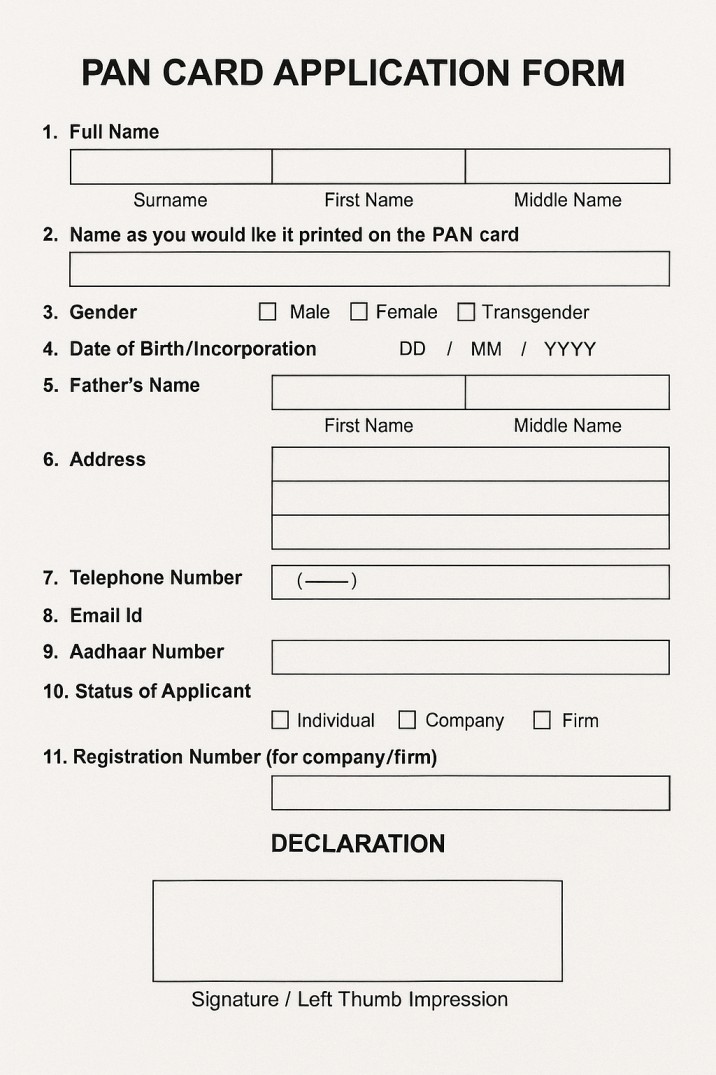
The Income-tax Act, 2025 — passed by the Indian Parliament on 12 August 2025 — replaces the six-decade-old Income Tax Act, 1961. Under the new Act and its corresponding Income-tax Rules, 2026 (specifically Rule 158, Section 262), PAN application forms have been completely restructured.
Instead of the two broad forms that covered all applicants, the government has introduced four category-specific forms. Each form now contains only the fields and instructions relevant to that specific type of applicant, making the process clearer and reducing errors.
PAN (Permanent Account Number) is a unique 10-digit alphanumeric identifier issued by the Indian Income Tax Department to individuals and entities. PAN is required for tax filing, property transactions, investments, bank accounts, and most financial activities in India. Once issued, PAN is valid for life and does not need renewal.
| New Form | Replaces | Who Should Use It | Legal Reference |
|---|---|---|---|
| Form 93 | Form 49A (individual portion) | Individual who is a citizen of India (includes NRIs with Indian passport) | Rule 158, Sec. 262 |
| Form 94 | Form 49A (entity portion) | Indian entities — companies, LLPs, trusts, HUFs, partnerships incorporated/formed in India | Rule 158, Sec. 262 |
| Form 95 | Form 49AA (individual portion) | Individual who is NOT a citizen of India (OCI holders, British citizens, foreign nationals) | Rule 158, Sec. 262 |
| Form 96 | Form 49AA (entity portion) | Foreign entities — companies, LLPs, trusts incorporated/formed outside India (UK LTDs, etc.) | Rule 158, Sec. 262 |
Applications pending as of 31 March 2026 under the old forms will continue to be processed normally — you do not need to resubmit. However, any new application filed on or after 1 April 2026 must use the new forms.
Not sure which form applies to you? Use the guide below. Simply identify your passport nationality and applicant type — and you'll know exactly which form to use when applying for your PAN card from the UK.
NRIs, ILR/Settled Status holders who retain Indian citizenship, Tier 2/Tier 5 visa holders with Indian passport
British citizens, OCI holders with UK passport, EU nationals, and all other non-Indian passport holders
UK LTD companies, LLPs, Trusts, Partnerships, and other organisations incorporated outside India
Companies, LLPs, trusts, HUFs, partnerships incorporated or formed in India
Form 93 (formerly Form 49A for individuals) is the PAN application form for any individual who is a citizen of India, as prescribed under Rule 158 of the Income-tax Rules, 2026. This form applies to all Indian passport holders regardless of their country of residence — whether living in the United Kingdom, Europe, or anywhere else.
Form 93 is the most commonly used form for PanCard.co.uk's UK-based clients who hold Indian passports. If you moved to the United Kingdom on a Tier 2 visa, came as a student, obtained Indefinite Leave to Remain (ILR) or Settled Status but kept your Indian citizenship, or are simply an NRI living and working in Britain — Form 93 is your form.
| Applicant Profile | Passport Held | Form | Notes |
|---|---|---|---|
| NRI living in the UK | Indian 🇮🇳 | Form 93 | Select "Non-Resident" as residential status |
| Tier 2 / Skilled Worker visa holder | Indian 🇮🇳 | Form 93 | Work visa does not change citizenship |
| Student visa holder in UK | Indian 🇮🇳 | Form 93 | Residential status depends on days spent in India |
| ILR / Settled Status holder | Indian 🇮🇳 | Form 93 | ILR ≠ British citizenship. If Indian passport is valid, use Form 93 |
| Indian citizen visiting UK | Indian 🇮🇳 | Form 93 | Residential status depends on number of days outside India |
| Minor child of NRI in UK | Indian 🇮🇳 | Form 93 | Parent applies as Representative Assessee |
Form 95 (formerly Form 49AA for individuals) is the PAN application form for any individual who is NOT a citizen of India, as prescribed under Rule 158 of the Income-tax Rules, 2026. This form applies to all foreign passport holders who need PAN for financial transactions in India — including OCI holders, British citizens, and nationals of any other country.
Form 95 is the primary form for PanCard.co.uk clients who hold British passports, EU passports, or any other foreign passport — even if they have an OCI card or Person of Indian Origin (PIO) status.
| Applicant Profile | Passport Held | Form | Notes |
|---|---|---|---|
| OCI holder in UK | British / Foreign 🇬🇧 | Form 95 | Select "OCI" as citizenship type. OCI card copy required. |
| British citizen | British 🇬🇧 | Form 95 | Passport + TIN (NINO/UTR) mandatory. |
| PIO cardholder | British / Foreign 🇬🇧 | Form 95 | Select "PIO" as citizenship type. PIO card copy required. |
| EU / EEA national in UK | EU passport 🇪🇺 | Form 95 | Non-Indian passport = Form 95. |
| ILR holder who became British citizen | British 🇬🇧 | Form 95 | Once you take British citizenship and surrender Indian passport, use Form 95. |
| Any other foreign national in UK | Any non-Indian | Form 95 | Any foreign passport holder needing PAN for India transactions. |
This is the comparison most UK-based applicants need. Form 93 and Form 95 are the two individual application forms — one for Indian citizens and one for non-Indian citizens. Here is every major difference between them.
| Feature | Form 93 (Indian Citizen) | Form 95 (Non-Indian Citizen) |
|---|---|---|
| Replaces | Form 49A (individual) | Form 49AA (individual) |
| Who uses it | NRIs, Tier 2 visa holders, ILR holders with Indian passport | OCI holders, British citizens, EU nationals, all other foreign nationals |
| Citizenship type field | No — citizenship is Indian by default | Yes — must select Foreigner, PIO, or OCI |
| Residential status field | Yes — Resident, NRI, or RNOR | No — all Form 95 applicants are non-citizens by definition |
| Mother's name | Mandatory | Collected but varies by applicant country |
| Aadhaar requirement | Mandatory (but NRIs exempt if 182+ days outside India) | Captured if available — NOT mandatory |
| Passport number | Mandatory for NRIs and RNORs | Mandatory for all applicants |
| TIN (Tax ID) | Mandatory for NRIs and RNORs (e.g. UK NINO) | Mandatory for all applicants (e.g. UK NINO / UTR) |
| Identity proof | Aadhaar, Indian passport, driving licence, voter ID, and more | Foreign passport, OCI card, PIO card, or apostilled foreign ID/TIN |
| Address proof | Aadhaar, passport, utility bills, bank statements | Passport, OCI/PIO card, foreign bank statement, UK utility bill, council tax bill |
| DOB proof | Birth certificate, passport, driving licence, voter ID | Passport, OCI/PIO card, apostilled foreign ID, birth certificate |
| Document attestation | Not required for standard Indian documents | Apostille or Indian High Commission attestation may be required for non-passport documents |
| Govt fee (foreign dispatch) | ₹1,017 (approx. £10) | ₹1,017 (approx. £10) |
| Govt fee (e-PAN only) | ₹66–72 | ₹66–72 |
| Edits after submission | Not allowed | Not allowed |
If you've applied for a PAN card before using the old forms — such as Form 49A or Form 49AA — here is exactly what changed and what stayed the same.
| What Changed | Old System (Until 31 March 2026) | New System (From 1 April 2026) |
|---|---|---|
| Form structure | 2 broad forms (49A for Indian, 49AA for foreign) covering both individuals and entities | 4 specific forms: Form 93 (Indian individual), Form 94 (Indian entity), Form 95 (foreign individual), Form 96 (foreign entity) |
| Correction form | CSF (Change or Correction Form) | Separate PAN change/correction request form (not 93/94/95/96) |
| Mother's name | Optional | Mandatory on Form 93 |
| Residential status | Not a specific field for Indian citizens | New field on Form 93: Resident / NRI / RNOR |
| Citizenship type | Not sub-categorised for foreign citizens | New field on Form 95: Foreigner / PIO / OCI |
| Contact details | Optional for some categories | Mobile and email mandatory for ALL applicants |
| Photo size | Standard passport-size | Increased size for better identification |
| Name format | Allowed salutations and abbreviations | No salutations, no initials (unless Aadhaar has initials) |
| DOB proof | Aadhaar alone was sufficient | Separate DOB proof now mandatory |
| Representative Assessee | Basic details collected | Mobile, email, PAN/Aadhaar of RA now mandatory |
Several important things remain the same. PAN itself is still a permanent, lifetime number — no renewal needed. The government fee structure has not changed (₹1,017 for foreign dispatch, ₹66–72 for e-PAN only). NRIs still do not need an Indian address — a foreign address is accepted on the form. The two authorised processing agencies are still Protean (formerly NSDL) and UTIITSL. And e-PAN delivery remains available — you can still receive your digital PAN within 3–5 working days. For a complete overview of the step-by-step application process, visit our dedicated procedure page.
Whilst most PanCard.co.uk clients are individuals, we also assist UK-based companies, LLPs, trusts, and other entities with PAN applications. Here is how the entity forms work under the new system.
Form 94 is for Indian companies, LLPs, firms, trusts, HUFs, AOPs, BOIs, and other entities incorporated or formed in India. This replaces the entity portion of the old Form 49A.
Form 96 is for foreign companies, entities incorporated outside India, and unincorporated entities formed outside India. This replaces the entity portion of the old Form 49AA. The Tax Identification Number of the entity is mandatory.
| Entity Type | Where Incorporated | Form |
|---|---|---|
| UK Limited Company (LTD) | United Kingdom | Form 96 |
| UK LLP / Partnership | United Kingdom | Form 96 |
| UK-based Trust | United Kingdom | Form 96 |
| EU / Foreign Company | Outside India | Form 96 |
| Indian Private Limited Company | India | Form 94 |
| Indian LLP / Partnership / HUF / Trust | India | Form 94 |
For entities, proof of date of incorporation has been made mandatory. An Authorised Representative (AR) can file on behalf of the entity, but the AR's identity proof, address proof, and contact details must also be submitted. For entities incorporated in the UK, the Companies House certificate of incorporation is required. For full details on company PAN applications, visit our dedicated entity page.
Document requirements vary by form type. Below are the complete lists as prescribed under Rule 158 of the Income-tax Rules, 2026, tailored for UK-based applicants.
Three categories of documents are required: proof of identity, proof of address, and proof of date of birth.
Proof of Identity — copy of any one: Indian passport (most common for UK-based NRIs), Aadhaar card, driving licence, voter ID, or government-issued photo ID.
Proof of Address — copy of any one: Indian passport (with UK address page), UK bank account statement (within 3 months), UK utility bill (electricity, gas, water, broadband — within 3 months), UK council tax bill, or UK driving licence showing current address.
Proof of Date of Birth — copy of any one: Indian passport (most common), birth certificate, driving licence, voter ID, marriage certificate, or matriculation certificate.
Two passport-size photographs — we accept standard UK passport photos (45mm × 35mm) available at any Boots, Snappy Snaps, or Post Office.
The same three categories apply but with different accepted documents.
Proof of Identity — copy of any one: British passport (most common), OCI card, PIO card, or other foreign national ID apostilled by the UK FCDO or attested by the Indian High Commission.
Proof of Address — copy of any one: British passport, OCI or PIO card, UK bank account statement (within 3 months), UK utility bill (within 3 months), UK council tax bill, UK driving licence, or NRE bank account statement in India.
Proof of Date of Birth — copy of any one: British passport (most common), OCI card, PIO card, UK birth certificate, or apostilled foreign ID containing date of birth.
Two passport-size photographs — same as Form 93. Standard UK passport photos are accepted through PanCard.co.uk.
The new PAN application forms (93, 94, 95, and 96) are available for download from the portals of the two government-authorised PAN service providers:
Protean (formerly NSDL eGov Technologies Limited) — Download forms from the "Downloads → PAN" section at protean-tinpan.com. Online applications can also be submitted directly on this portal.
UTIITSL (UTI Infrastructure Technology and Services Limited) — Download forms from utiitsl.com. Both online and physical submissions are supported.
Applications can be submitted online through either portal, but you must still send signed physical documents with photographs by post or courier to India after online submission. Government portals accept payment in INR only, which can be inconvenient for UK residents.
Alternatively, a dedicated PAN card agency like PanCard.co.uk handles the entire process — form filling, document review, submission, and tracking — so you only need to sign the form and post it. You can pay in GBP using any UK debit or credit card, and we accept standard UK passport photos. Since 2007, we have helped over 50,000 UK-based clients with their PAN applications.
Based on our experience assisting over 50,000 UK-based applicants since 2007, these are the top form-related errors that lead to PAN application rejections — and how to avoid each one.
Common questions about PAN card application forms for NRIs, OCI holders, British citizens, and foreign nationals in the UK — answered clearly.
No. From 1 April 2026, Form 49A has been replaced by Form 93 (for Indian citizen individuals) and Form 94 (for Indian entities). Form 49AA has been replaced by Form 95 (for foreign citizen individuals) and Form 96 (for foreign entities). The old CSF correction form has also been replaced by a separate PAN change/correction request form.
Applications already submitted under the old forms before 31 March 2026 remain valid and will be processed normally. Only new applications filed from 1 April 2026 onwards must use the new forms.
An NRI living in the United Kingdom who holds an Indian passport should use Form 93. This form is for individuals who are citizens of India, regardless of where they reside. Whether you're in London, Birmingham, Manchester, Edinburgh, or any other UK city, your Indian citizenship determines the form — not your country of residence. Select "Non-Resident" as your residential status on the form.
OCI holders who carry a British (or any non-Indian) passport must use Form 95. Even though OCI cardholders have strong ties to India, OCI is not Indian citizenship. Form 95 is for individuals who are not citizens of India. You must select "OCI" as your citizenship type on the form and submit your OCI card as part of your documentation. This is one of the most common confusion points we see amongst our UK-based clients. To understand the difference between OCI and PAN, visit our dedicated page.
Yes. Any British citizen — with or without an OCI card — can apply for a PAN card using Form 95 if they have financial interests in India such as property, investments, bank accounts, or business dealings. You would use your UK passport as your identity document and select "Foreigner" as your citizenship type on Form 95. Having an OCI card is not mandatory for a PAN application.
Aadhaar is listed as mandatory on Form 93 for Indian citizens. However, NRIs who have been outside India for more than 182 days in a financial year fall under an exempted category and can apply without Aadhaar. In practice, the vast majority of UK-based NRI applicants do not have or need Aadhaar. Your Indian passport plus a valid TIN (such as your UK National Insurance Number or HMRC UTR) are the key documents. If you do have Aadhaar, include it — but it is not a blocker.
No. Under the new 2026 rules, edits are not allowed after final submission of Forms 93, 94, 95, or 96. If you need to make corrections after your PAN has been allotted, you must submit a separate PAN change/correction request form. This is why reviewing every detail before submission is critical — and a key reason many applicants use a professional agency like PanCard.co.uk that reviews the form for errors before filing.
The Indian government fee for PAN applications with a foreign communication address is ₹1,017 (approximately £10). For e-PAN only (no physical card), the fee is ₹66–72. Through PanCard.co.uk, we charge a flat fee in GBP that covers the government charges, our service fee, and postal delivery to your UK address — with no hidden charges. You can pay using any UK debit or credit card. Check the exact current fee on our procedure page.
The new PAN application forms are available for download from the official portals of the two authorised PAN service providers: Protean (formerly NSDL) at protean-tinpan.com and UTIITSL at utiitsl.com. Look under the "Downloads → PAN" section. Alternatively, PanCard.co.uk provides the correct pre-identified form as part of the application kit when you start your process with us.
The old CSF (Change or Correction Form) has been replaced by a new PAN change/correction request form under the 2026 rules. If you already have a PAN and need to update your name, address, date of birth, photograph, or signature, you must submit the correction request form — not Forms 93 or 95, which are only for new PAN allotment.
Any UK-based Limited Company, LLP, Trust, Partnership, or entity incorporated outside India must use Form 96. Form 94 is only for entities incorporated or formed within India. The Tax Identification Number of the entity (such as the HMRC Company UTR) is mandatory. The certificate of incorporation from Companies House is required as proof. Visit our Company PAN page for full details on entity applications.
Yes. You can opt for e-PAN only (digital PAN card) during the application process, regardless of which form you use. The e-PAN is delivered to your email address and is accepted by banks, property registrars, and other institutions in India as valid proof of PAN. Through PanCard.co.uk, e-PAN is typically delivered within 3–5 working days.
For most UK-based applicants using PanCard.co.uk, attestation or apostille is not required. A valid passport (Indian or British) and a UK address proof (utility bill or bank statement) are typically sufficient. However, if you are submitting foreign documents other than a passport, OCI card, or PIO card as your identity proof for Form 95, those documents may need to be apostilled by the UK Foreign, Commonwealth & Development Office (FCDO) or attested by the Indian High Commission in London. Our adviser will confirm what is needed for your specific case.
Through PanCard.co.uk, your e-PAN (electronic version) is typically delivered to your email within 3–5 working days after your application is successfully processed. The physical PAN card is dispatched via India Post and usually arrives at your UK address within 3–4 weeks. You can track the status of your application online using the acknowledgement number provided. For the full step-by-step breakdown, see our application procedure page.
PAN is not mandatory for all NRIs. However, it is legally required if you earn income in India (such as rental income, capital gains, interest, or dividends), own or plan to buy/sell property in India, wish to open or operate NRE/NRO bank accounts, invest in Indian mutual funds or shares, or need to file income tax returns in India. Without a PAN, you may also face higher tax deducted at source (TDS) rates on your Indian income.
There is no physical difference — the PAN card looks identical whether issued to a resident Indian or an NRI. The key distinction is in how it is used and the tax rules that apply. NRIs are generally taxed only on income earned or accrued in India, whereas resident Indians are taxed on their worldwide income. The application process also differs: NRIs apply using their overseas address and may use different identity documents. For a detailed comparison, visit our NRI PAN vs Normal PAN page.
Whether you need Form 93 or Form 95, PanCard.co.uk handles the form selection, filling, document review, and submission for you. Just sign and post — we take care of everything else.
No hidden charges. Your e-PAN delivered in 3–5 working days.
Sources: protean-tinpan.com | utiitsl.com | incometax.gov.in | Income-tax Rules, 2026 — Rule 158, Section 262
Last Updated: April 2026 | Page: pancard.co.uk/application-form.html
